From Humble Beginnings…
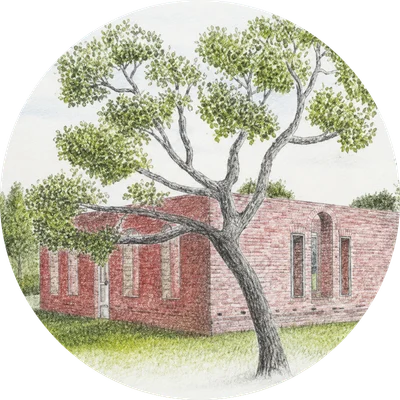
St. Philip’s Parish was created for Port Brunswick in 1741.
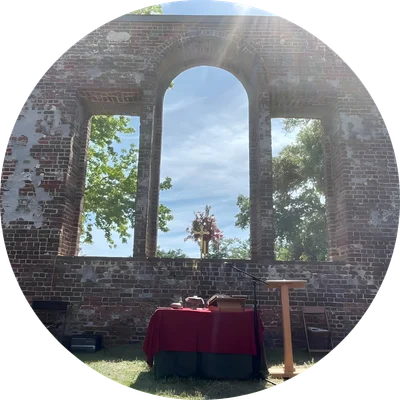
Less than a decade after it’s creation, Spanish privateers captured the Port of Brunswick in 1748 and held it for several days. During this time, the Spanish flag flew over the parish of Old St. Philip’s. Construction of St. Philip’s Church at Brunswick Town began in 1754, and in the spring of 1760 Royal Governor Arthur Dobbs announced his intention of designating St. Philip’s Church as His Majesty’s Chapel in North Carolina. St. Philip’s was completed and dedicated in 1768, and served the town of Brunswick until the structure was burned by the British during the American Revolution in 1776. The remains of the original church building still stand at Brunswick Town, preserved as a state historical site off Highway 133, approximately ten miles north of Southport. Supposedly, the altar rail in the Chapel of the Cross at St. Philip’s came from the original structure.
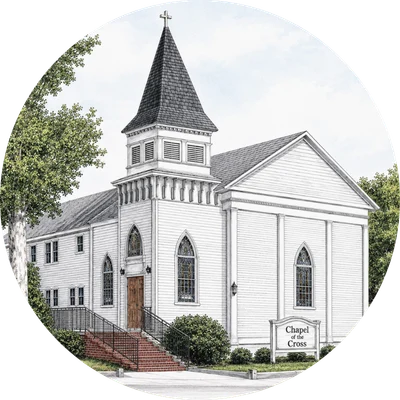
Chapel of the Cross at St. Philip’s Church
The Chapel of the Cross at St. Philip’s Church was erected in 1843.
The commander of Fort Johnston at that time, Colonel Thomas Childs, is said to be partly responsible for the church’s construction. Evidently, Colonel Childs desired a church to serve the fort, and his soldiers were supposedly used as labor to build the church. Today, Fort Johnston is directly across the street from our church, and for many years was used by the U.S.. Army as a residence for the Commander and other staff of The Military Ocean Terminal at Sunny Point. The earliest record for a full-time rector was the Rev. Peyton Gallagher, leading St. Philip’s from June, 1852 to March, 1853. The first vestry was elected in 1850, and in 1851 the parish was admitted into the diocese as “Old St. Philip’s.” It was the intention of its members at that time to perpetuate the memory of the original church of Brunswick Town, through the existence of the new parish. The church continued to flourish, and in an address to the diocesan convention in 1860, Bishop Atkinson reported that he had consecrated St. Philip’s Church in “Smithville,” as Southport was unknown at that time. The original structure is preserved as a state historical site off Highway 133, approximately ten miles north of Southport. Supposedly, the altar rail in the Chapel of the Cross at St. Philip’s came from the original structure.
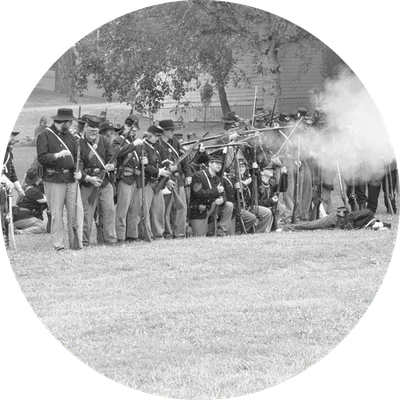
In February of 1865, the Union seized the Church.
In February of 1865, after the evacuation of Fort Johnston by Confederate forces, the church was immediately seized and occupied by Union forces. It was used as a hospital for their wounded, and later as a school for African-American children. From March, 1876 to March, 1878 the church grew and again prospered. A small addition was made to the vestry room and church was enclosed with a “proper fence.” During this period Colonel A.C.M. Pennington and his command of U.S. troops stationed at Fort Johnston were responsible for acquiring a new communion table, alms basin, and lectern. A new organ was also obtained during this period.
Since its creation in 1741, St. Philip’s has withstood many changes and challenges. It has worshiped under seven different political flags.
The Labyrinth at St. Philip’s
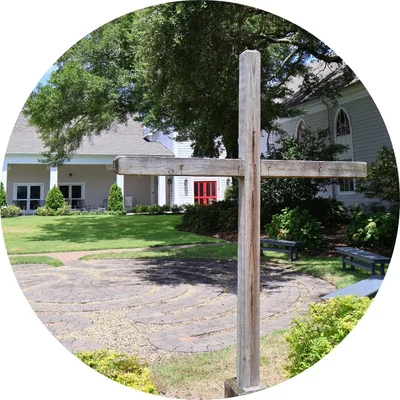
The St. Philip’s Labyrinth is available 24/7 for meditative walking and peaceful reflection.
A labyrinth is a spiritual tool that has been around for thousands of years. It is a single walking path for prayer and meditation (and sometimes just for fun) leading to a center space and returning to its beginning. Unlike a maze, there are no dead ends or choices to right or left – only a clearly defined pathway to follow. Walking the labyrinth quiets the mind, allowing one to reflect, to receive and to renew.
Our Labyrinth is a five-circuit, neo-medieval cruciform design. In other words, there are five paths (circuits) which encircle the center space. Within this new (neo), yet centuries old (medieval) design, the shape of a cross (a cruciform) is created, dividing the design into four quadrants with various bends and turns.
Personalized Pavers
Personalized pavers are available to be incorporated into the pathway. If you would like to purchase a paver engraved with your family’s names(s) or with a special sentiment, verse, or date to commemorate, please print and return the form below to the church office. Prepayment of $60.00 is required. Checks should be made payable to St. Philip’s with PAVER on the memo line. The inscription must fit in a grid of squares 4×14.
History of the Episcopal Church
The beginnings of the Church of England, from which The Episcopal Church derives, date to at least the second century, when merchants and other travelers first brought Christianity to England. It is customary to regard St. Augustine of Canterbury’s mission to England in 597 as marking the formal beginning of the church under papal authority, as it was to be throughout the Middle Ages.
In its modern form, the church dates from the English Reformation of the 16th century, when royal supremacy was established and the authority of the papacy was repudiated. With the advent of British colonization, the Church of England was established on every continent. In time, these churches gained their independence, but retained connections with the mother church in the Anglican communion.
